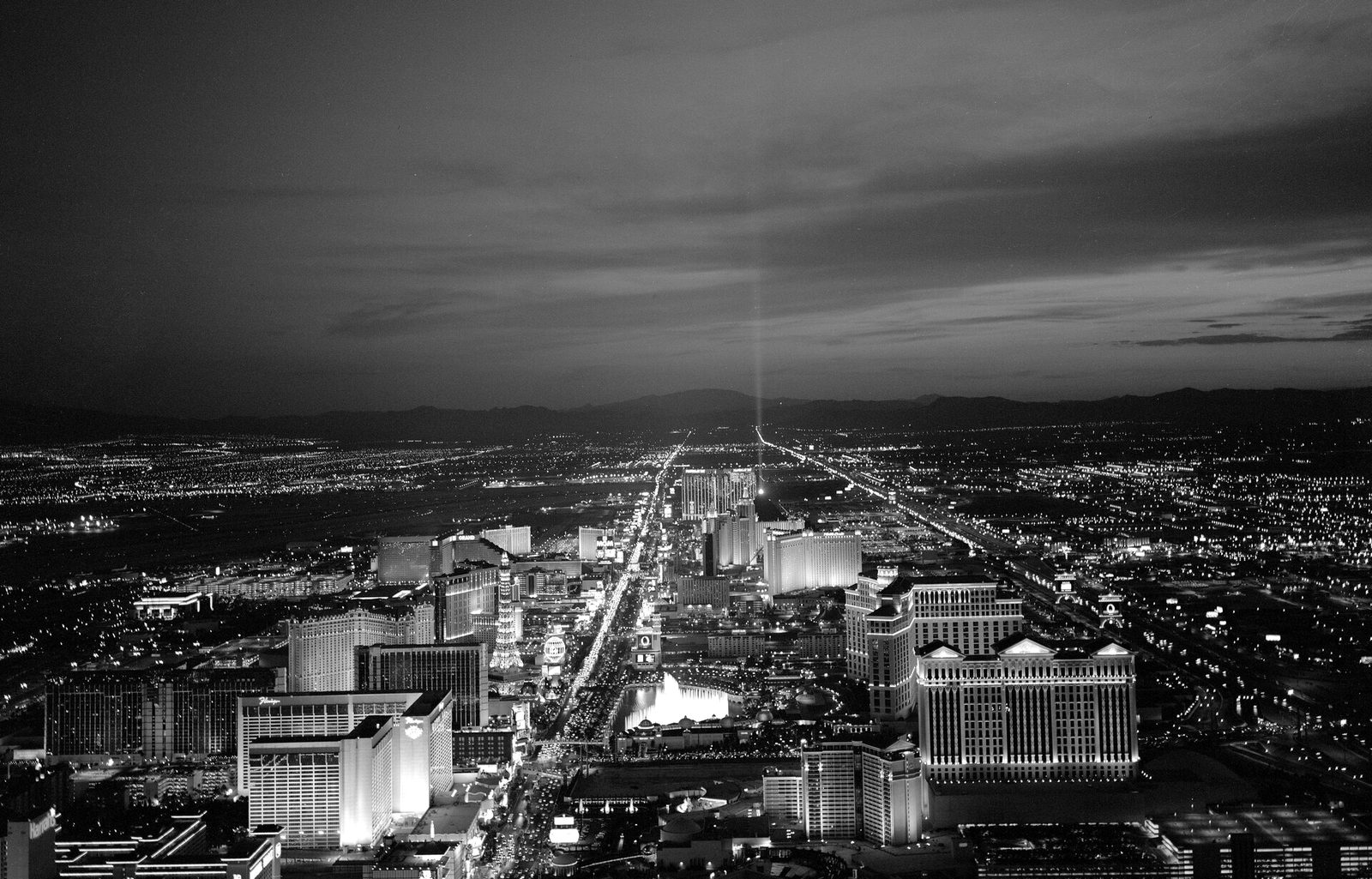
Walk into a casino on the Las Vegas Strip and the architecture tells you what the business is. The slot machines occupy the path between the entrance and the elevator. The table games fill the center of the floor. The lights, the sounds, the carpet designed to keep you looking forward. Everything is arranged to hold your attention at the tables.
In 2024, gaming accounted for 35% of Las Vegas Strip resort revenue. The other 65% came from hotel rooms, restaurants, bars, entertainment, retail, and conventions.1
The casino floor is the most visible part of the operation. It is not most of the operation. It has not been most of the operation for more than twenty-five years.
What the revenue said
The UNLV Center for Gaming Research tracks departmental revenue for Nevada casinos back to 1984. The data describes a forty-year structural shift that happened in plain sight.
In 1984, gaming generated 59% of all revenue at the large Las Vegas Strip resorts. Rooms, food, beverage, and everything else combined for the remaining 41%. The casino floor was the business. The hotel was the place you slept between sessions at the tables.
By 1999, gaming had fallen below 50% of Strip revenue for the first time. Non-gaming had overtaken it. The crossover came in the twelve months that opened the Bellagio, Mandalay Bay, and The Venetian. Paris Las Vegas followed that September. The new properties were not designed to maximize time at the tables. They were designed to maximize time on the property.2
The ratio never reversed.
Source: UNLV Center for Gaming Research, "Nevada Casinos: Departmental Revenues, 1984–2024." Las Vegas Strip resorts. Bank of America Merrill Lynch confirmed the 1999 crossover.By 2024, the twenty-six largest Strip casinos generated $8.25 billion in gaming revenue. Rooms, food and beverage, entertainment, nightlife, and retail together generated almost twice that. Gaming was still the largest single department, and it was barely a third of the business at the properties built to showcase it.3
The chart tells a story nobody inside a casino would guess. The line falls steadily, year after year, for four decades. Not because gaming revenue declined. It grew. But every other revenue stream grew faster. The business moved around the casino floor while the casino floor stayed the same.
The margins
A blackjack table with a player using basic strategy gives the house an edge of roughly half a percent. Baccarat: just over one percent. Craps, on the pass line: 1.4%. Roulette is the outlier at 5.3%, and even that number describes how much the house expects to keep from each dollar wagered, not from each visit or each customer.4
Then subtract what the casino pays to run the floor. Dealer wages. Pit boss salaries. Surveillance. Complimentary drinks. Nevada's 6.75% tax on gross gaming revenue. Equipment maintenance. Bad debt from markers that never get repaid. The house edge is thin before any of these costs. After them, the gaming floor at the big Strip resorts keeps about 53 cents of every dollar it wins. The hotel rooms keep about 72.
Entertainment, retail and other: 56.8%
Casino: 52.7%
Beverage: 50.7%
Food: 18.5%
Source: Nevada Gaming Control Board, via UNLV Center for Gaming Research, "Nevada Casino Departmental Income, 1990–2024," February 2025, Big Las Vegas Strip table (casinos with more than $72 million in gaming revenue). Departmental income before utilities, taxes, corporate payroll and interest, so not profit. From fiscal 2019, comps are subtracted from gaming revenue, which raised the casino margin.
A hotel room has near-zero marginal cost once the building exists and the staff is employed. The room is empty or it is occupied. A $270-per-night room at 92% occupancy generates more predictable revenue than any table game. The slot machines run themselves. The hotel rooms are more profitable.
In 2017, the Westin Las Vegas, a hotel just off the Strip, took out its casino floor entirely and put a restaurant, a lobby bar and new meeting rooms where the slot machines had been.5
The most dramatic proof sits inside a single company's financial statements.
Wynn Resorts operates properties in Las Vegas and Macau under the same brand, the same management standards, and the same operational philosophy. In fiscal year 2024, Wynn reported revenue by department for each property.
Wynn Las Vegas
Wynn Macau
At Wynn Las Vegas, rooms generated more revenue than the casino. Food and beverage generated more revenue than the casino. The gaming floor produced $600 million out of $2.57 billion in total Las Vegas revenue. Everything else produced $1.97 billion.6
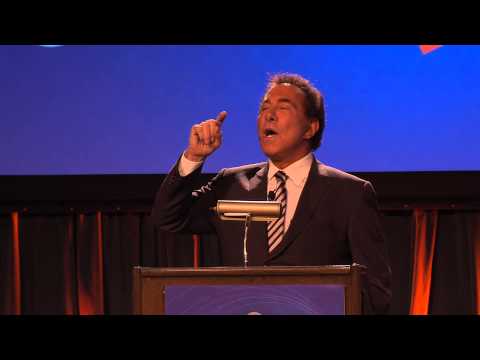
G2E 2014 Steve Wynn Full Keynote
American Gaming Association
At Wynn Macau, the inverse. Casino revenue was $1.23 billion out of $1.46 billion. The gaming floor was 84% of the business.
Same company. Same brand. Same operator. Different model. The Las Vegas version is a hospitality company that operates a casino. The Macau version is a casino that operates a hotel. One is a choice. The other is now being forced by regulators to change.
When the Macau government renewed the six casino concession licenses for ten years from January 2023, it attached a requirement. Operators must invest a combined $13.6 billion in non-gaming infrastructure over the term. Conventions, exhibitions, entertainment, performance venues. Macau is being required by regulation to adopt the model Las Vegas adopted voluntarily twenty-five years ago.7
How the model flipped
The Las Vegas Strip in the mid-1980s was a gaming operation. The rooms were cheap. The food was cheap. The buffets lost money on purpose. Everything existed to keep the customer at the tables for one more hour. The casino was the business. The hotel was the cost of doing that business.
In November 1989, Steve Wynn opened the Mirage.
The property cost $630 million, financed largely through $525 million in junk bonds arranged by Michael Milken. At the time, a large Strip casino cost around $200 million. Wynn was building something three times more expensive and funding it with the riskiest instruments on Wall Street. The Strip was deteriorating. Atlantic City had legalized gambling. The 1980 MGM Grand fire had killed 85 people. Occupancy had fallen from 77% to 70%. Some operators were building RV parks.8
Wynn's thesis was that the gaming floor alone could not justify air travel. As the writer Brian Phillips put it, Wynn understood that what middle-class tourists want from a gambling destination is the feeling of escaping from the middle class. The Mirage had a volcano on the sidewalk, a 20,000-gallon aquarium behind the registration desk, and Siegfried & Roy performing nightly. None of it had anything to do with the odds at the tables.
Visitation to Las Vegas increased 16% in 1990, one of the largest year-over-year gains in the city's history.9
Nine years later, Wynn built the Bellagio. Cost: $1.6 billion, the most expensive hotel ever constructed at the time. Eight-acre artificial lake with a choreographed fountain show visible from the Strip. Cirque du Soleil's "O" in a custom-built aquatic theater. A gallery of fine art. Fourteen restaurants, several operated by chefs who had never worked in a casino before. Randy Morton, the property's president and COO, credited its success to being built just as dependence on the casino as the main profit center was lessening.10
The sequence accelerated from there. CityCenter opened in 2009, an $8.5 billion mixed-use development, one of the largest privately funded construction projects in American history. It included a non-gaming hotel, a luxury retail center, and residential towers. T-Mobile Arena opened in 2016 as a freestanding entertainment venue with no casino attached. Allegiant Stadium followed in 2020 at a cost of $1.9 billion. The Sphere opened in 2023 for $2.3 billion. No gaming at all. In 2025, it generated $781 million in revenue.11
At a gaming industry conference in 2014, Wynn addressed the question directly.
"It's always been that the noncasino story was the story. It was never the slot machines. They've been everywhere for centuries."12 Steve Wynn, G2E Global Gaming Expo, September 30, 2014
He told the audience that at every Strip property he had built, nongaming revenue exceeded gaming revenue. The Mirage. The Bellagio. Wynn Las Vegas. Encore. He was not describing a recent trend. He was describing what he called the way it had always worked.
"You got to give people something they're willing to get on an airplane and submit to a body search for. That ain't a slot machine, friends, and it sure as hell ain't a baccarat table."12
After winning the license to build Boston's first casino-hotel, Wynn designed a property with an entrance that would tuck slot machines and table games out of sight. The casino as hidden infrastructure. Not the showcase.
Where the value sits
In 2019, MGM Resorts sold the Bellagio's real estate for $4.25 billion to a venture 95% owned by a Blackstone-managed fund. MGM continued to operate the property under a long-term lease. The building changed hands. The casino license did not. The management did not. The gaming operations stayed the same.13
Four years later, Blackstone sold a 22% stake in the Bellagio to Realty Income Corporation at a valuation of $5.1 billion. The real estate had appreciated $850 million, roughly 20%, while entirely separated from gaming operations. The building got more valuable. The casino was irrelevant to the gain.14
This is part of a broader structural separation that has reshaped the industry. VICI Properties, a real estate investment trust that was spun out when Caesars Entertainment's operating unit emerged from bankruptcy in 2017, now owns the land and buildings underneath dozens of the largest casino resorts in the country. In 2022, VICI acquired MGM Growth Properties for $17.2 billion, making it the largest private landowner on the Las Vegas Strip with more than 660 acres.15
In March 2026, VICI's enterprise value was $46.2 billion. One hundred percent occupancy across 93 properties. Triple-net leases that insulate the landlord from gaming volatility. The tenants pay property taxes, insurance, and maintenance. VICI collects rent.
The landlord is worth more than the operators. The entity that owns the buildings, the land, and the parking structures, that has no gaming license and runs no table games, is more valuable than the companies whose names are on the marquees. The value is in the real estate. It was always in the real estate.
The same inversion surfaced during the $18 billion bankruptcy of Caesars Entertainment's operating unit in 2015. Creditors fought over the assets. The most contested asset was not the casino properties. It was Total Rewards, the customer loyalty database containing the behavioral data of 44 million members. Gary Loveman, a Harvard Business School professor who became Caesars' CEO, had built the program into a data operation that tracked 300,000 to one million customer visits daily. The system generated a 22% revenue premium per gaming unit compared to competitors. Creditors put the database's value at more than $1 billion. Caesars put it at zero.16
The buildings went to a REIT. The data stayed with the operator. The same separation that happened when airlines pledged their loyalty programs as collateral worth more than the aircraft.
The race next door
In June 2022, Liberty Media, the company that had spent the previous five years transforming Formula 1 from a racing series into a media and franchise platform, purchased a 39-acre parcel of land on the Las Vegas Strip for $240 million. Two months earlier, the company had announced it would host a Grand Prix on a street circuit running past the casino resorts.17
Total investment in the facility: roughly $500 million. A 300,000-square-foot permanent paddock building. Pit infrastructure designed for year-round use. Liberty Media is the only F1 promoter that owns the physical venue. At every other race on the calendar, a local promoter pays a hosting fee and operates the event. In Las Vegas, the championship owns the land.
The first race, in November 2023, lost money. The second improved significantly. By the third year, Guggenheim Securities assessed the event as "directionally break-even," with profitability expected by the fourth race.18
In 2025, Liberty opened the paddock facility as Grand Prix Plaza, a year-round entertainment complex with go-karts, an interactive F1 museum, racing simulators, and event space. The ten-year extension Clark County approved in May 2026, which keeps the race in Las Vegas through 2037, signals the intent. The race runs for three days in November. The buildings operate 365 days a year.19
The model is legible. The race is the draw. The real estate is the business. Three days of competition justify a $500 million permanent infrastructure investment that generates returns for decades. The event breaks even. The surrounding economics pay for everything.
Liberty Media did not invent this. It copied the building next door.
The casino resorts surrounding the circuit operate on the same structure. The gaming floor draws visitors to the property. The rooms, restaurants, bars, convention space, retail, and entertainment generate the majority of the revenue. The house edge keeps the lights interesting. The hotel room pays the mortgage.
During the 2024 race week, race visitors spent an average of more than $2,400 each outside the race itself, nearly double what a typical visitor spends. The casino operators did not raise their slot payouts or add table games. They raised their room rates.20
What the floor is for
In 2024, the Las Vegas Convention and Visitors Authority reported 41.7 million visitors to the city. Total direct visitor spending: $55.1 billion. Total economic impact: $87.7 billion.21
Seven percent of those visitors cited gambling as their primary reason for coming.
The Las Vegas Convention Center reopened its Central Hall after a $600 million renovation in January 2026, giving it 2.5 million square feet of indoor exhibit space. Convention attendance reached 6 million in 2024. The average convention visitor spent about $1,700 per trip that year, a third more than the average leisure visitor. The LVCVA's CEO said 2026 "has a chance to be the best group meeting and trade show year in the history of Las Vegas."22
The slot machines are still on. The table games are still dealt. The sounds are the same sounds they have always been. A first-time visitor would walk through the casino floor and conclude that gambling is the point of the building. The experienced visitor walks through the casino floor on the way to something else.
Steve Wynn said it was always the story. The UNLV data says it became measurably true in 1999 and has only accelerated since. The Bellagio's real estate is worth more separated from its gaming license than attached to it. The landlord who owns the buildings is worth more than the companies that run the tables. Macau, the world's largest gaming market, is being forced by its own government to build what Las Vegas built voluntarily: a business that does not depend on the casino floor.
The house didn't gamble. It built hotels.
Sources
- UNLV Center for Gaming Research, "Nevada Casinos: Departmental Revenues, 1984–2024." Las Vegas Strip resorts: gaming at 35% of total revenue in 2024. Confirmed by Bank of America Merrill Lynch research note (Business Insider, "Las Vegas Hasn't Been About Gambling Since 1999," March 9, 2013). ↩
- Business Insider, March 9, 2013, citing Bank of America Merrill Lynch. Gaming fell below 50% of Strip resort revenue in 1999. UNLV figures are fiscal years (July to June). Bellagio (October 1998), Mandalay Bay (March 1999) and The Venetian (May 1999) opened in fiscal 1999, the crossover year; Paris Las Vegas followed in September 1999. ↩
- UNLV Center for Gaming Research, "The Average Big Las Vegas Strip Casino 2024." Twenty-six casinos with $72M+ gaming revenue. Gaming $8.25 billion (34.5% of total), rooms $7.20 billion, food $3.97 billion, beverage $1.58 billion, other $2.88 billion; total $23.89 billion (fiscal 2024). Room rate $271.14, occupancy 92.2% (fiscal 2024). ↩
- Robert C. Hannum, "Casino Mathematics: Understanding Casino Math," International Association of Casino Surveillance Professionals / UNLV Center for Gaming Research. House edges: blackjack basic strategy 0.5%, baccarat (banker) 1.06%, craps pass line 1.41%, roulette (double-zero) 5.26%. ↩
- Las Vegas Sun, "Westin Las Vegas renovation: nongaming, nonsmoking," January 22, 2018. The 826-room hotel at 160 E. Flamingo Road removed its casino floor and all gaming, replacing it with the Jake & Eli restaurant and lobby bar and new meeting space. ↩
- Wynn Resorts Q4/FY2024 earnings release, February 13, 2025. Wynn Las Vegas: casino $600.1M (23.3%), rooms $845.7M (32.9%), F&B $778.5M (30.3%), entertainment/retail/other $347.6M (13.5%). Total Las Vegas: $2,571.9M. Wynn Macau: casino $1,230.4M (84.0%). Wynn Palace: casino $1,795.6M (81.0%). Gambling Insider, February 2025. ↩
- Macau concession renewals (January 2023): six operators required to invest a combined $13.6 billion in non-gaming projects over ten years. VOA, "Can Macao Become Asia's Las Vegas?," 2024. CNBC, "Macao becomes more than a gambling destination," October 9, 2025. Contracts signed December 2022 (non-gaming pledge MOP 108.7 billion). The non-gaming commitment rose by 20 percent after Macau's 2023 gaming revenue passed MOP 180 billion (Yogonet, November 20, 2025). ↩
- Brian Phillips, "A Mirage in the Desert," The Ringer, July 20, 2021. Mirage financing: $630M total, $525M in Milken-arranged junk bonds. Strip context: Atlantic City competition, MGM Grand fire (November 21, 1980; 85 deaths per the Clark County Fire Department; The Ringer and the Review-Journal give 87), occupancy decline from 77% to 70%, 300,000 fewer visitors in 1982 vs. 1980. UNLV gaming historian David Schwartz: Las Vegas "mostly had $200 million casinos at that time" (Las Vegas Review-Journal, July 12, 2024). The middle-class line is Phillips's narration, not a Wynn quotation. ↩
- LVCVA historical visitor data. Las Vegas visitation increased approximately 16% in 1990 following the Mirage opening (November 22, 1989). ↩
- Las Vegas Review-Journal, "Bellagio, born in 1998, reset the bar for Las Vegas Strip." Bellagio cost: $1.6 billion. Randy Morton, paraphrased by the Review-Journal, on the resort being built as dependence on the casino as the main profit center was lessening (Richard N. Velotta, October 15, 2018). In 2017, Bellagio generated 1.5x the operating income of MGM Grand. Brent Pirosch (CBRE Gaming): "Those fountains don't just sell the property, they sell the whole Strip." ↩
- CityCenter: $8.5 billion, opened December 2009 (GGB Magazine, "CityCenter: Evaluating Las Vegas' Biggest Ever Gamble"). T-Mobile Arena: 2016. Allegiant Stadium: $1.9 billion, 2020. Sphere: $2.3 billion, opened September 2023. Sphere segment revenue, twelve months ended December 31, 2025: $781.4 million; segment adjusted operating income (non-GAAP) $144.6 million. Company total of $1,220.0 million includes $438.6 million from MSG Networks. Sphere Entertainment Co. earnings release, February 12, 2026. ↩
- Steve Wynn, G2E Global Gaming Expo keynote, September 30, 2014. "It's always been that the noncasino story was the story." And: "That ain't a slot machine, friends, and it sure as hell ain't a baccarat table." Vegas Inc / Las Vegas Sun, September 30, 2014. Associated Press / Reno Gazette-Journal, October 1, 2014. Las Vegas Review-Journal, June 7, 2016. ↩ ↩
- MGM Resorts / Blackstone Bellagio sale-leaseback: Blackstone REIT and MGM formed a 95%/5% joint venture that bought the Bellagio real estate for $4.25 billion (announced October 15, 2019, closed November 2019). MGM continued to operate the property under a lease. ↩
- Blackstone / Realty Income: 22% Bellagio stake sold in August 2023 at $5.1 billion total valuation. Bisnow, August 25, 2023. Realty Income press release, August 2023. ↩
- VICI Properties: acquired MGM Growth Properties for $17.2 billion (including $5.7B assumed debt) in April 2022. Enterprise value $46.2 billion and equity market capitalization $29.6 billion as of March 31, 2026; 93 experiential assets including 54 gaming properties; 100% occupancy (VICI Q1 2026 financial supplement, SEC Form 8-K). By the second quarter of 2026 the portfolio was 103 assets. 660+ acres on the Las Vegas Strip. Business Wire, April 29, 2022. ↩
- Caesars Entertainment Chapter 11 bankruptcy (January 2015, approximately $18.4 billion in debt at Caesars Entertainment Operating Company, from a $30.7 billion Apollo/TPG leveraged buyout). Gary Loveman and Total Rewards: 44 million members, 300,000–1 million daily customer tracking, 22% revenue premium per gaming unit. Creditors asserted Total Rewards was worth more than $1 billion; Caesars attributed no value to it in the asset transfers at issue (Las Vegas Advisor, 2015). Harvard Business School Digital Innovation case study; Penn State IS textbook, Ch. 11.8; iGaming Business, October 21, 2021. ↩
- ESPN, "F1 Owners Liberty Media to Buy Las Vegas Land for $240M," June 2022. 39 acres at $6.15M/acre. CoStar, June 2022. Race announced March 30, 2022 (Formula 1 release dated March 31, 2022). Land purchase disclosed in early May 2022 and closed in early June 2022 (FOX5, June 2, 2022). ↩
- Guggenheim Securities analysis, March 2026: Las Vegas GP "directionally break-even" in year 3, profitability expected year 4. Investing.com, March 2026. ↩
- Grand Prix Plaza opened in the Las Vegas Grand Prix Pit Building in 2025 (opening set for May 2, 2025, Formula 1 release, February 27, 2025) with F1 X, F1 DRIVE karting and F1 HUB simulators; it reopened with a redesigned karting track in 2026. Clark County commissioners approved a ten-year extension through 2037 on May 19, 2026; Formula 1 announced it June 4, 2026. ↩
- Applied Analysis, "2024 Las Vegas Grand Prix Economic Impact Analysis" (released March 4, 2025): visitors stayed 3.7 nights and spent more than $2,400 each on non-race expenditures, excluding race tickets, "nearly 2X the typical, non-Formula 1 visitor." The LVCVA's 2024 per-visitor average was $1,322. ↩
- LVCVA Research Center. 2024: visitor volume 41.7 million, direct visitor spending $55.1 billion, total economic output $87.7 billion (LVCVA, Economic Impact of Visitors 2024). Harry Reid International Airport: 58.4 million passengers (2024). In 2025, visitation fell 7.5 percent to 38.5 million and visitor spending to $50.8 billion. ↩
- LVCVA: 2024 convention attendance 5,994,800 (Historic Tourism Statistics). Average convention visitor spent $1,681 per trip, 33.2% more than the $1,262 spent by the average leisure visitor (Economic Impact of Visitors 2024). Central Hall ribbon cutting January 5, 2026, after a $600 million renovation; 2.5 million square feet of indoor exhibit space on a 4.6-million-square-foot campus (Casino.org and CDC Gaming, January 5-6, 2026). Steve Hill, LVCVA president and CEO: "2026 has a chance to be the best group meeting and trade show year in the history of Las Vegas." Skift Meetings, September 4, 2025, repeated January 7, 2026. Seven percent of visitors cited gambling as primary reason for visiting (LVCVA 2024 Visitor Profile). ↩